
f you are placing meaningful volume in Asia in 2026, you are probably circling the same dilemma: do you keep most production in China, move more aggressively into Southeast Asia, or design a proper China+1 setup without turning operations into chaos?
There is no one-size-fits-all answer. But there is a right answer for your product type, your margin structure, and your tolerance for risk and change. The question is not simply “China or Vietnam?” It is: which story sounds most like your brand over the next three to five years?
This guide looks at three realistic models—China as anchor, ASEAN as main base, and a planned China+1 mix—and then shows how to keep multi-country sourcing under control and pick a direction without drowning in slide decks.
When a China-Anchored Strategy Still Makes Sense
Ecosystem vs. single factory
For many brands, staying anchored in China is not about ignoring risk; it is about recognizing how much value sits in its industrial ecosystems.
If your products have long bills of materials, many custom parts and tight launch calendars, you are not just buying a factory. You are buying the cluster around it. In China’s mature hubs, your lead plant can draw on multiple component makers, seasoned tooling shops, finishing and packaging specialists, and local labs that already know your customers’ test protocols. When something goes wrong two weeks before launch, that density is what lets you switch an anodizing supplier, tweak a tool or redo packaging in days instead of weeks.
To visualize the specific roles, industrial strengths, and key differences across Southeast Asia’s manufacturing powerhouses, and to see real-world examples of how they compare on the ground, you can watch this video.
Engineering speed matters more than hourly wages
For categories like electronics, smart devices, machinery, EV components, medical or industrial equipment, the real constraint is rarely the hourly wage on the line. It is the speed and quality of engineering work: how quickly designs can be iterated, how fast tools and fixtures can be modified, and how reliably changes stick in production.
The better Chinese suppliers are used to reading 3D drawings, challenging weak areas, proposing design-for-manufacturing improvements and implementing engineering changes on realistic timelines. If your business lives on six- or twelve-month product cycles, a few weeks saved on every change can matter more than a few dollars of labour cost saved somewhere else.
Tariffs hit some portfolios harder than others
Tariffs complicate the picture, but do not affect every brand in the same way. If your sales are spread across China itself, wider Asia, the Middle East, Europe and North America, US–China duties may only hurt a slice of your portfolio. Goods made in China and sold domestically or within Asia can still be the most efficient combination of cost and speed.
That’s why many global brands have stopped asking “Should we leave China entirely?” and instead ask which specific SKUs and destinations are suffering most from tariffs, which of those could realistically move to Vietnam or another ASEAN country, and what that would do to risk, cost and service.
What you actually gain by staying
When brands consciously choose to stay anchored in China, what they are really buying is accumulated knowledge and predictability. Long-term suppliers already know their quality standards, compliance rules, carton markings, routing guides and typical failure modes. Engineering and tooling changes are handled inside a familiar ecosystem. Vessel frequency and consolidation options from major ports support smaller batch sizes and flexible replenishment. All of this reduces the “teaching cost” of every order and the amount of firefighting your own team has to do.
The trade-off you accept
The trade-off is straightforward. You accept higher exposure to the US-China tariff policy on affected lanes, rising wages and compliance costs in core regions, and concentration risk if something serious breaks in that jurisdiction. For complex, engineering-heavy products with aggressive launch calendars, many brands still see that as a reasonable price compared with a rushed relocation and one to two years of instability.
If that description feels close to your reality, you are a natural candidate for a China-anchored strategy, with diversification done slowly, deliberately and in focused slices of your portfolio.
When an ASEAN-Centric Strategy Fits Better
When cost and tariffs dominate the story
Now imagine a different profile: a US lifestyle brand selling apparel, bags and home goods, or a European company focused on packaging, simple furniture or basic metal parts. Tariffs on China hit directly, margins are tight, and the products are labour-intensive rather than deeply engineered. In that world, your centre of gravity starts to move toward Southeast Asia.
Vietnam is the natural first move
Vietnam is usually the first serious alternative. It has become the natural base for garments, footwear, bags, packaging, basic furniture and simpler metal and plastic parts.
The attraction is a mix of competitive wages versus Chinese coastal provinces, export-oriented industrial zones that improve year by year, and a workforce already used to supplying US and European retailers. When your SKUs are reasonably stable, and your main problem is cost and tariff pressure rather than deep engineering complexity, Vietnam can reduce landed cost while still delivering the quality your customers expect, provided you are disciplined about which factories you work with and how you manage quality.
How Thailand, Malaysia and Indonesia fit in
Beyond Vietnam, the rest of ASEAN is not one big undifferentiated “China replacement.”
Thailand brings a more mature base in automotive, appliances and electronics. Wages and land costs are higher than in Vietnam, but so are productivity and infrastructure reliability, which makes Thailand a better fit for higher-value goods where reliability and tighter process control matter more than rock-bottom cost.
Malaysia leans toward higher-value electronics, medical devices and precision work. Strong IP protection, English proficiency and regulatory stability suit smaller but high-value lines where you cannot afford surprises.
Indonesia offers scale: a large labour pool and a growing manufacturing base, attractive for simpler assemblies and bulky goods, especially where local raw materials play a role. At the same time, inland logistics and bureaucracy tend to be slower and require more patience.
An ASEAN-centric strategy is not “move everything to the cheapest country.” It is about picking the part of ASEAN that fits your category and risk profile.
When ASEAN becomes the logical base
An ASEAN-centred setup tends to work best when a large share of your US or EU volume is penalised by China tariffs, your core products are labour-intensive rather than engineering-heavy, and you can accept a learning curve of several months as new partners ramp up. The wins show up as lower direct labour cost, a better tariff position on key lanes and a second manufacturing engine outside China.
In return, you give up some of China’s speed, scale and engineering depth, at least at the beginning. For many brands, this is a reasonable trade as long as expectations are realistic and no one assumes you can copy-paste the entire Chinese ecosystem into a new country overnight.
How a China+1 Mix Works in Practice
“Both” instead of “either/or”
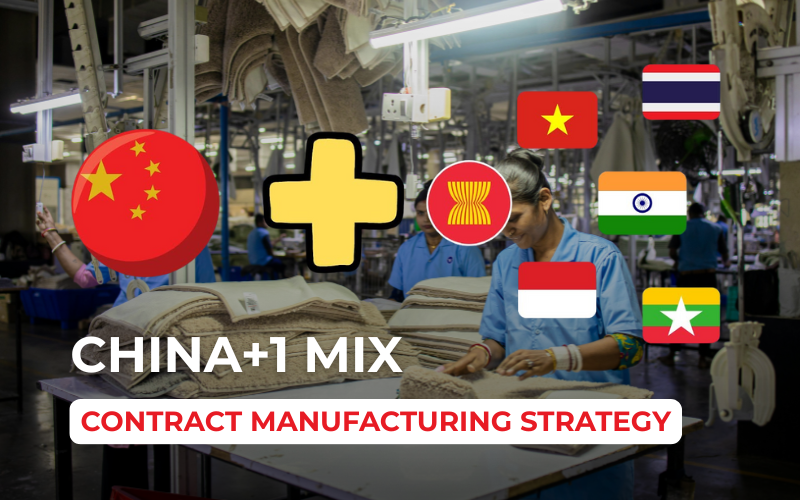
For many mid-sized and larger brands, the most realistic answer is “both”: keep China and build a serious alternative beside it. That is what a genuine China+1 strategy looks like once you get past slogans.
In a healthy China+1 setup, you do not scatter tiny trial orders across three countries. You keep complex, engineering-heavy SKUs in China, where the ecosystem is strongest, and move simpler, labour-heavy or tariff-sensitive SKUs into Vietnam or another ASEAN country. The second country is treated as a real production base and capacity hedge, not just a box in a presentation.
Splitting work by what each location does best
A typical pattern keeps smart-home hubs, routers and complex devices in China, while shifting textile accessories, bags, packaging and lower-complexity peripherals to Vietnam. US-bound SKUs in certain product families might be prioritized for ASEAN production to improve duty exposure and resilience.
The operational detail that makes this work is standardization. Both locations use the same drawings, spec packs, test plans and quality standards, so changing the volume split becomes an operational lever, not a full redesign.
Why a staged shift often beats a big exit
This mixed approach appeals when you recognize China’s strengths but do not want to be fully exposed to one country. It suits organizations whose teams can handle some extra complexity but cannot absorb a dramatic overnight relocation. It also gives negotiating leverage and an insurance policy: if pricing, lead times or politics in China deteriorate, you already have a second base that understands your products and processes.
Brands that succeed with China+1 usually move in phases. They shift one coherent product family and destination lane into ASEAN and learn on that scope. Once that flow is stable, they scale what works, adding another family or another lane. Each year they review cost, service and risk, then rebalance volumes. Over a few years, they end up with meaningful volume outside China without having blown up their existing business along the way.
Keeping Multi-Country Sourcing Under Control
Decide who is the anchor and who is the backup
The main fear with moving beyond a single-country model is not abstract risk; it is everyday complexity. Too many factories, too many origins and a planning team that feels like it is running three separate businesses instead of one.
You can avoid that by designing a basic structure from the start. The first element is clarity about your anchor and your relief valve. Decide which country is the base that will carry most of your volume—often still China or Vietnam—and which country is the pressure-release option you will build around it. Most mid-sized brands perform better with one core base carrying the majority of volume and one secondary base grown around a clear role, rather than trying to launch three or four equal hubs at once.
Move by product family, not by random SKU
The second element is how you move work. Shuffling individual SKUs back and forth between countries generates confusion and extra effort. Moving full product families or ranges does the opposite. Your quality and packaging teams only need to learn a new setup once. The factory can build a stable line and gain experience across variants. Performance and cost can be compared in a way that actually helps you decide what to do next.
Standardize the basics across countries
The third element is standardization. Wherever you can, you keep a single master spec pack per product, one shared quality checklist and AQL approach, and harmonized cartons, pallet patterns and labelling. The more you do this, the easier it is for warehouses, 3PLs and customers to treat output from different countries as interchangeable.
Put someone firmly in charge
Finally, even if production is spread out, coordination does not have to be. Someone needs clear ownership of Asia sourcing and manufacturing—either a small internal team or an external sourcing and quality partner—with responsibility for RFQs, audits, shared quality frameworks and reporting across factories and countries. With that in place, multi-country sourcing feels like managing a portfolio rather than fighting a dozen separate fires.
A Simple Way to Decide Which Model Fits Your Brand
Start with product complexity
Most management teams do not need a giant strategy document. They need a starting point that fits their reality.
A useful way to choose between a China-anchored strategy, an ASEAN-centred base or a structured China+1 mix is to ask a few blunt questions internally. The first is about product complexity. If your core lines depend on dense ecosystems, specialized sub-suppliers and frequent design changes, a China-anchored or China+1 model is usually safer than a rapid exit. If your core lines are labour-intensive and relatively simple, ASEAN deserves a much closer look.
Follow where the margin really leaks
The second question is where your margins are actually being squeezed. If tariff exposure on China is the main pain point and you sell into markets where ASEAN has better trade terms, shifting part of your portfolio there may give immediate relief. If your bigger worry is disruption—sanctions, export controls, sudden logistics shocks—then the ability to run real volume from a second country becomes more important than shaving the last cent from unit cost.
Be honest about change capacity
The third question is how much change your team can absorb over the next two years. One carefully chosen new country and one product family that you move and stabilize is usually better than a grand multi-country plan nobody can execute. It is easier to add a second family later once the first wave is working than to untangle a rushed rollout.
Clarify what scares you most
The final question is what keeps you awake more: slow cost drift or sudden discontinuity. If gradual cost creep is the main enemy, pushing more volume into ASEAN makes sense. If you are more afraid of a sharp break—sanctions, export bans, a severe logistics shock—then having a structured China+1 with real volume in a second location is the right direction.
Once those conversations have happened, the choice stops being abstract. “Strategy” turns into a sequence of concrete steps: which product family to move first, which destination lane it serves, which factory and which country will take it, and what roles China, Vietnam, and the wider ASEAN region will each play over the next three to five years.
If you want help turning that into a usable roadmap, with specific factories, realistic timelines and someone on the ground to keep both sides aligned, this is exactly the kind of work a buyer-side partner like FVSource, MoveToAsia, Sourcing Notes,… does. We sit between international brands and Asian manufacturers so that the model you choose on paper is one your operations team can actually live with.